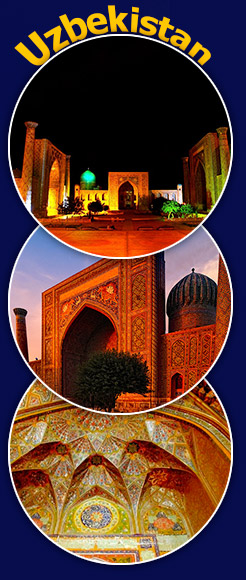
Tales of 1000 years
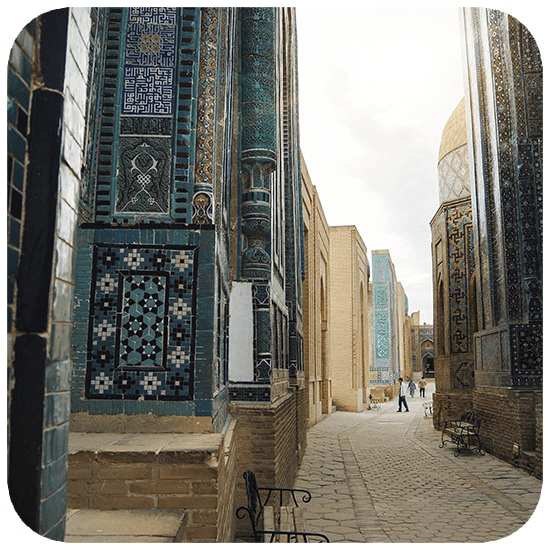
Name of tour: Tales of 1000 years
Duration: 9 days & 8 nights
Day 1: Tashkent
As you land at the airport your guide will take you to Tashken, the capital city of Uzbekistan. The entire day will be devoted to a guided tour of the city. You will go to the main square of Independence which was built to signify the Victory over fascism in the Great Patriotic War. Also you will get to walk along the local Broadway which is located between independence square and square of Amir Timur. After that you can take a famous metro of Tashkent which is considered to be one of the most beautiful subways in the world. IT was built in 1977. The old parts of the city are what you visit next. It includes Chorsu Bazaar, Kukaldash Madrasahs, several madrasahs, mosques, and mausoleums within the complex of Hast Imam. The latter features the world’s oldest copy of the Quran which dates back to the XIII century. It was a property of Othman Ibn Affan who was the Third Caliph out of four righteous Caliphs who were successors of the prophet Muhammad. He was killed in the VIII century by nonmuslims. His blood can still be seen on the pages of the Quran. The night is in the hotel.
Day 2: Tashkent – Nukus
You will take a flight to Nukus early in the morning during your travel. The day will fully be devoted to a city tour. You will witness the masterpieces of forbidden art in the museum of Savitsky. The museum features a collection of russian avant-garde paintings from the 20th century, works of Sokolov Komarovskiy and Amaravella. The museum also has a collection of banned works of the artists who were persecuted by the soviet government. Curator of the museum purchased them in the early 1960s. We continue our tour outside of Nurkus. We will drive to visit Mizdakhan necropolis which once was a city. Finding from this area confirmed the fact that this place was inhabited in the time period of 4th to 14th century AD. You will also get to see Chilpyk which is an ancient zoroastrian monument that dates back to second century BC. Overnight is in the hotel.
Day 3: Nukus – Ayaz Qala – Tuprak Qala – Khiva
Our final destination for the day is the most ancient city of Uzbekistan, Khiva. It has a rich history and fascinating sites. Its history ties to the state of Khorezmshah. The capital of the latter was once in Urgench. In the 10th century Khiva was one of the important cities on the Great Silk Road. Before we reach our destination, we will make a few stops at famous fortresses of Ayaz Qala and Turpak Qala. The first one is a castle of Khorezm built in the name of famous warrior-slave Ayaz. Ayaz is a hero of turkic folklore. The castle was built in the 2nd century AD. The fortress of Turpak Qala, the name of which means a “clay fort”, was the city of Khorezmian ruler. The fortress is proven to be built in about the same era as the previous one, in the 1-2 centuries AD. The fortress was abandoned in the 6th century after numerous wars and invasions that exhausted the city and left it with no single sign of life. After sightseeing we continue our way to Khiva. Overnight is in the hotel.
Day 4: Khiva – Bukhara
We will be driving to the beautiful city of Bukhara to continue your tour. Bukhara is often regarded as a “town museum” due to the fact that it has 140 well preserved architectural monuments that date back to the Middle Ages. Narrow streets, green parks, and gardens are all over the city. You can see fine examples of architecture of different time periods standing one next to another. On our way from Khiva to Bukhara we will get a fascinating view of the deepest river in Central Asia, the river Of Amu Darya. It flows through the famous desert of Kizilkum (red sand) and finally reaches the Aral Sea. Once you get to Bukhara you are welcome to enjoy your free time. The night is in a hotel.
Day 5: Bukhara
Bukhara is such an interesting and fascinating city that the whole day alone will be devoted to sightseeing. First, we will stop at the Citadel Ark, the most ancient citadel that dates back to the 4th century. It was used as a palace by several dynasties of the Bukhara Empire. The next stop is the mausoleum of Samanids which belongs to the 9th - 10th century. It is indeed an architectural masterpiece. Then we head to the mausoleum of Chashma Ayub. Its name stands for Job’s well, due to legend that says that Job was the one to visit the place and make a well striking the ground with his stuff. We will also visit the mosque of Bolo-Hauz. It is well known as the mosque of forty columns and was built to honor the ruler of Bukhara, Abu-Fayed Khan. Next, we will go walking along the shopping domes. Also you will get to see Nodir Divan Begi, the famous madrasahs of Bukhara. It is also a part of another central sightseeing, Lyabi House Ensemble. Poi Kalon complex is the last destination for the day’s tour. Three structures of the 12th - 16th century makeup this complex. They are Kalon minaret, Kalon mosque and Mir Arab Madrasah. The night is in a hotel.
Day 6: Bukhara
The day will be devoted to travelling in the surrounding areas of the city. Our first stop is Bahuddin Naqshbandi memorial complex 12 km from Bukhara. It is a complex of one of the Sufi leaders and philosophers. It is considered to be one of the pilgrimage places for all muslims around the world. One of the spiritual masters of the Great Amir Timur was Sheikh Bakhauddin Nakshbandi. The complex itself includes the mosques of Kushbegi and Muzafarohana along with madrasah, burial vaults of Bukhara rulers, courtyard with pool, and, of course the tomb of Bahauddin Nakshbandi. The next stop is Sitorai Mohi Hosa complex which includes the use of different architectural styles throughout the palace. The palace itself was named by Emir of Bukhara in honor of his wife who passed away at a young age. Finally we will drive to the village of Sumiton to see the memorial complex of Chor Bakr. It is also known as the town of the dead. The structure of the complex points at four cardinal points and gets interpreted as a symbol of equality of all people. The complex belongs to the reign of Samanids. After that we drive back to the city. The night is in a hotel in the city.
Day 7: Bukhara – Gijduvan – Samarkand
We start driving to Samarkand in the morning. On our way, there is a village of Gijduvan which is famous for its pottery workshops. Certainly, we will stop at the village to see it. The ceramics school of Gijduvan has its own interesting and long history. As the generations passed, so did the mastery and skills necessary for the craft. Today, there is a sixth generation mastering this craft in the village. What distinguishes the works of Gijduvan School of ceramics is the unique use of geometric patterns with bright green and blue colors. After visiting the village we get back on our way to Samarkand where you have an overnight stay in a hotel.
Day 8: Samarkand – Tashkent (transfer or train)
You will take a train or drive to Tashkent in the morning. The day will be devoted to a guided tour of the city. Courage Monument is the first site to be visited. This memorial complex was erected to honor the elimination of consequences of the earthquake that took place in Tashkent. The next stop is Zangi Ota memorial complex. There are legends about a shepherd Zangi Ota who was praised for his wisdom and good will. You will also get to see the State Museum of Timurids’ history. The museum accounts for more than 3000 different items of jewelry, musical instruments, weaponry, coins of the past. It also has an interesting inventory of works of art, historical documents, and manuscripts that are relevant to the Timurids’ period. State Museum of Applied Arts of Uzbekistan rounds up our city tour. The museum has a number of interesting exhibits: glasses, national clothing, fabrics, carpets, woodcarving.
You will be staying in a hotel.
Day 9: Flight
Transfer to the airport is in the morning.