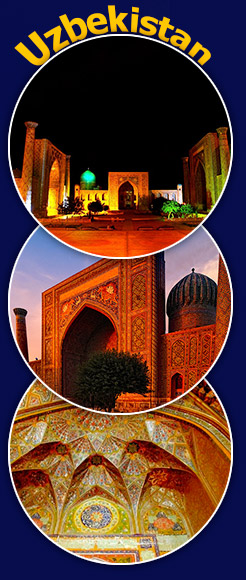
Samarkand
One of the oldest towns in Central Asia can be considered Samarkand which is regarding 2,500 years. Just as we read history of Samarkand city we can know the fact it was absorbed by distinguished battlers like Alexander the Great, the Army of the Arab Caliphate, and the Mongol invasion beneath the leader of Chenghis Khan. Proverbial amid towns of Central Asia is Samarkand city because numerous fighting and wars take place there and it is known as prosperous city now.
The portion of Mount Afrasiab (Afrosiab) was Samarkand city; to the north section of Samarkand was reached it. The bounds of Samarkand were enlarged in the XIX century and practically whole of terrain of the hill was taken by the area of Samarkand city. In XIX centenary on the south portion of the territory of the mount were framed diversity vicinity with market, caravanserais, bathhouse and mosques. The water system was disposed in town in that period of time. But lots of privation with water delivery system had Afrasiab in the same time, and multiple problems with water trumpet were subsisted there.
When Samarkand city was vanquished by the Mongol invasion and in that period was blasted old water supply system and Mongol penetration broke Afrasiab.
When Samarkand city was vanquished by the Mongol invasion and in that period was blasted old water supply system and Mongol penetration broke Afrasiab.
At the present time the deathlike mount may be seen but it is necessary for folk in time to perform the artistically culture of the past. All the construction of the past period of time was broken-down and destroyed by Mongol invasion. All structures were built by people who stay on alive for them and their babies necessary almost century. Once more was formed destroyed Samarkand on that spot where was populated exurban. The Shakhi-Zindah necropolis renovation occurred in that time when Afrasiab and reminiscence had been applied such as a religious place and public regard here was disposed entombment of Kusam ibn-Abbas. In the time of the last quarter of XIV century had a high altitude organization of holy necropolis and mausoleum for the people from Timur’s family so to say to his army leader and his bridegrooms was constructed in that time. Back to the second half of XV century can be pertained Shakhi-Zindah tout ensemble and its structures and that time devoted to the Ulug Beg’s period of time. The adored painted and adorned gateways of the years 1434 -1435 may be pertained to that period of time and gateways were situated on the basis of Mount Afrasiab. In size the mausoleum was expanded and master high-colored it with two exalted turquoise dome presumably over the entombment of the stargazer of Ulug Beg's teacher Kazy-zade-Rumi.
You have pedestrianism by the ways which have overpast to the mausoleums are related to the Timur period. Structure of astonished show of majolica covering and tile mosaics had done by foremen of that time period. In 1372 the mausoleum in honor to Shadi-Mulk-aka was created and also for her mom Tour-kan-aka, Timur's sister. Now can be visited the mausoleum. With blocks of sumptuous carved glazed terracotta in combination with majolica are decorated the gateways of mausoleum and mausoleum’s revetment. The way which is gone among the mausoleums spend to winsome shadowy courtyard which is placed near to the mausoleum faithful Tournan-aka which was formed in betimes XV century, and the mausoleums were framed prior to the Timur’s period and devoted to people of Khoja Akhmad and unknown. In 1404-1405 door was framed and with glamorous carvings was glossed over and in the style of ivory inlay was used the tracery. XV century mosque with mausoleum faithful to Kusam ibn-Abbas through the yard where you can walk. The dyed enameled revetment of Shakhi-Zindah mausoleum is fantastic. The stone masons are connected the glorious structures into the single architectural ensemble with artistically corroborative behooved one to different over a centuries.
The metropolis of the enormous Empire of Timur was considered to be Samarkand reading the historical facts. In the 1399-1404 was constructed very swift the Bibi-khanum mosque. With burnished brick with huge number of geometrical scenic styling were fronted the splendid walls of magnificent mosque. This styling of architecture is regarded to be the basic peculiarity of the forming structures which were used for Timur.
In 1403-1404 was built the mausoleum in honor of Gur-Emir and in the line of Timur's constructions in Samarkand city was considered to be the last and for the entombment for his sons, for Ulug Beg who was his grandchild and for himself was applied this mausoleum. The mausoleum was famous as a formation of the complex which was included two constructions. The madrasah and khana-gah are these facilities, improbable form has the structure and as the third side of yard was applied it. The surprising formation of facility has the fourth side of yard because the notes were glossed over with surprising glazed tile mosaics.
In the XV century was hakim Ulug Beg and the structures during that period of time were unassuming for notables because of their extraspecial form and the revetment color: the entries, the mausoleums which were put in honor to Kazy-zade-Rumi, the Shakhi-Zindah octangular wondrous madrasah in Reghistan, the enormous quadrate which was an enormous partition of the city in 1420. Ulug Beg's observatory is celebrated because of tracery which located outside Samarkand. After Ulug Beg’ death has been derelict his observatory and was all in ruins to the XVI century.
In XV century were formed huge amount of architectural ensembles and manifold monumental facilities. The tout ensemble in honor to Khoja Abdi-Darun will be the best instance.
In the XVI century became again the capital of Uzbekistan Bukhara city and were constructed in Samarkand city in those times not so diversity structures, and after lifeblood encroachments were perished enormous amount of structures. In the XVII century was created in honor to Shir-Dor the Madrasah Shir-Dor (1619-1636) on that place where the now disappeared khana-gah of Ulug Beg was stayed. The structure was allocated in the same place the Ulug Beg Madrasah was mounted. Not in all in size but also in all were different their structures. You will see Tillah-kari Madrasah on the third side of Reghistan Square which in 1646-1660 was constructed. In time Timur's Bibi-khanum mosque was destroyed in that time the Friday mosque with the complicated and Tillah-kari Madrasah were emerged.
In the XVI century became again the capital of Uzbekistan Bukhara city and were constructed in Samarkand city in those times not so diversity structures, and after lifeblood encroachments were perished enormous amount of structures. In the XVII century was created in honor to Shir-Dor the Madrasah Shir-Dor (1619-1636) on that place where the now disappeared khana-gah of Ulug Beg was stayed. The structure was allocated in the same place the Ulug Beg Madrasah was mounted. Not in all in size but also in all were different their structures. You will see Tillah-kari Madrasah on the third side of Reghistan Square which in 1646-1660 was constructed. In time Timur's Bibi-khanum mosque was destroyed in that time the Friday mosque with the complicated and Tillah-kari Madrasah were emerged.
After the XVII century was extremely exchanged the location of the country because of architecture development in Samarkand city. As industrial and as cultivated centers of Uzbekistan was considered to be Samarkand.